Let Our Packaging Experts Review Your Project
Share your packaging requirements before you leave. Our experts can review your dieline, artwork, materials, inserts, finishing, certifications, MOQ, quality checks, and delivery expectations.

Getting a useful price for custom paper packaging is not as simple as entering a box size and order quantity.
Dimensions, material construction, printing colors, surface finishes, wall thickness, closures, inserts, barrier linings, and order volume can all change the final manufacturing cost. If these specifications are missing from an RFQ, the first price you receive may be little more than a rough estimate.
A packaging cost calculator can help you define these variables before contacting a supplier. Instead of asking, “How much does a custom box cost?”, you can build a much clearer specification and obtain a cost estimate that is closer to the quotation a packaging manufacturer can prepare after reviewing your project.
Below are three custom paper packaging cost calculators designed for different packaging structures: shipping mailer boxes, custom paper tubes, and paper canisters.
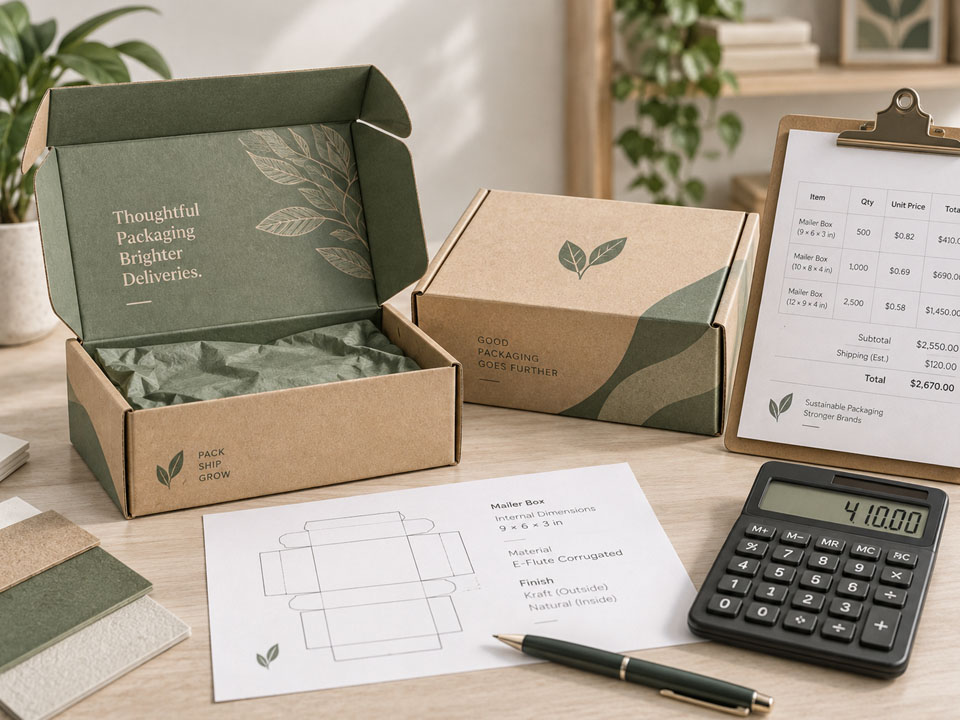
If you are sourcing corrugated mailer boxes for eCommerce, subscription packaging, promotional kits, retail shipments, or branded product delivery, the Shipping Mailer Box Cost Calculator is a practical place to start.
Try the Shipping Mailer Box Cost Calculator
Rather than estimating a price from dimensions alone, the calculator allows buyers to define several of the variables that normally influence custom mailer box production.
These include:
The tool then provides an estimated unit price and total packaging cost based on the selected configuration.
Mailer box prices can change substantially when the structure, dimensions, board requirements, printing, and finishing change.
For example, increasing the size of a corrugated mailer does more than make the finished package larger. It generally increases material consumption and can also affect the overall economics of packing and shipping.
Likewise, a simple printed kraft mailer and a fully printed promotional mailer with lamination, foil stamping, and Spot UV should not be expected to have the same unit cost.
The calculator makes it easier to change individual specifications and compare different packaging configurations before requesting a formal quotation.
This is particularly useful for:
The calculator itself identifies dimensions, quantity, material, printing, lamination, finishing, and accessories as important pricing variables.
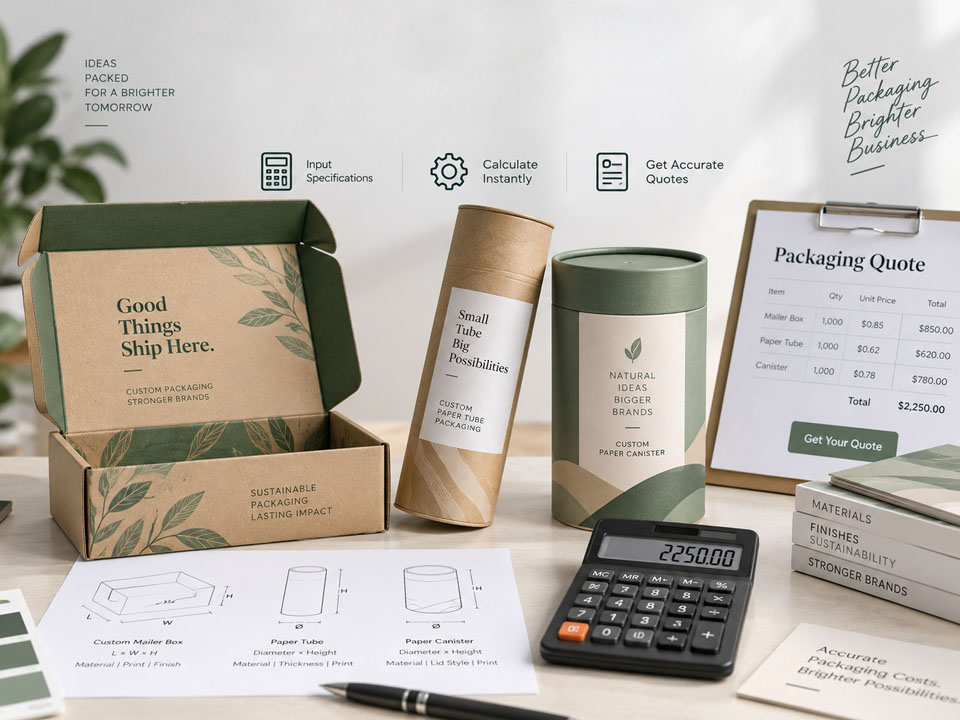
Round paper tubes have a different manufacturing structure from corrugated mailer boxes, so they require a different pricing model.
The Custom Paper Tube Cost Calculator is designed specifically for buyers sourcing cylindrical paper packaging.
Try the Custom Paper Tube Cost Calculator
It allows users to build an estimate using variables including:
These inputs are particularly relevant to custom tube manufacturing because relatively small changes to diameter, height, decoration, or construction can change material usage and production requirements.
The calculator is useful for paper tube packaging used for products such as:
For packaging buyers, the main advantage is the ability to test specifications before entering a full sourcing process.
For example, a procurement manager can compare different quantities or remove a premium finish to see how the estimated price changes. A packaging engineer can test different tube dimensions. A brand manager can compare a simpler printed tube against a version with foil, embossing, or other premium decoration.
The calculator states that its pricing logic considers China market data related to raw materials, labor, printing, finishing, and other production costs. Its purpose is therefore to provide a practical sourcing benchmark before a formal factory quotation is requested.
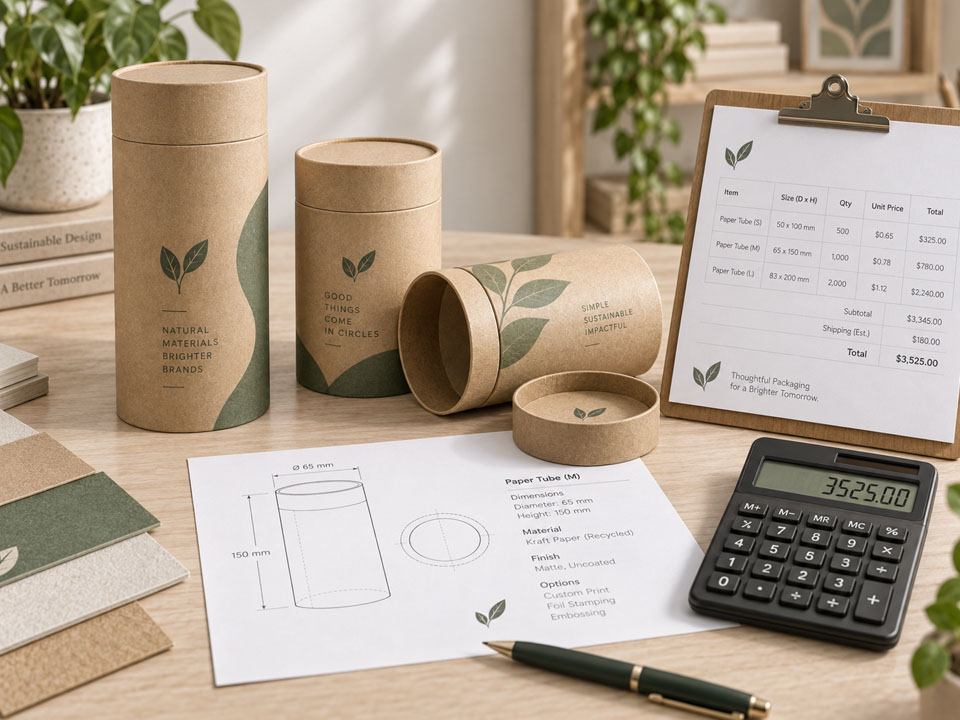
Not every cylindrical package is a conventional gift tube.
Food, coffee, tea, protein powder, spices, supplements, and similar products can require more specialized canister construction, including barrier materials, internal linings, different wall thicknesses, membranes, or alternative lid systems.
For these projects, the Custom Paper Tube Cost Estimator from PaperCanister.com provides a more specialized configuration.
Try the Paper Canister Cost Estimator
The estimator allows users to specify factors such as:
The site specifically identifies wall thickness, internal lining, order volume, and print complexity as factors that can influence paper tube and canister pricing.
A basic paper tube and a food-grade composite canister may look similar from the outside, but their production requirements can be very different.
Coffee, tea, powders, spices, and similar products may require additional barrier performance. A foil-lined structure, for example, is more complex than a standard all-paper tube.
Closures can also affect manufacturing cost. Depending on the application, buyers may need a paper friction-fit lid, metal component, membrane, or another closure system.
That makes this estimator particularly relevant for projects involving:
The estimator lets buyers include these structural variables earlier in the budgeting process instead of treating all cylindrical packaging as the same product.
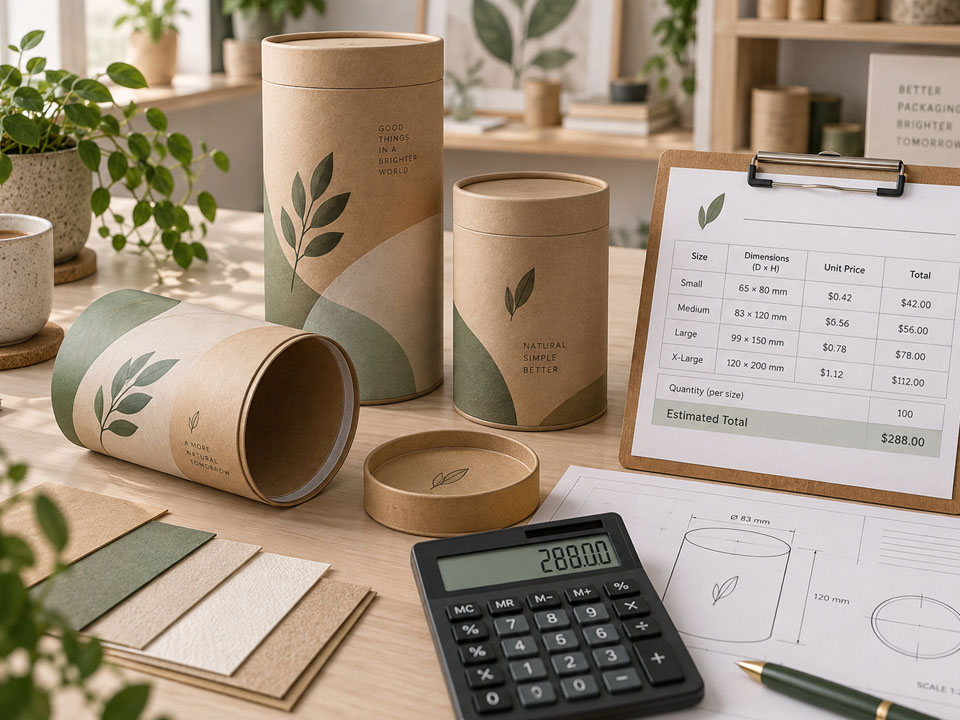
The right calculator depends primarily on your packaging structure and product requirements.
| Packaging Project | Recommended Calculator | Key Pricing Variables |
|---|---|---|
| Corrugated shipping mailer box | Shipping Mailer Box Cost Calculator | L × W × H, quantity, board, printing, lamination, finishing |
| Standard or premium paper tube | Custom Paper Tube Cost Calculator | Diameter, height, quantity, Pantone colors, material, lamination, finishes |
| Food-grade or barrier paper canister | Paper Canister Cost Estimator | Diameter, height, lid, wall construction, lining, closure, quantity |
For a branded eCommerce shipping box, start with the mailer box calculator.
For cosmetics, candles, perfume, apparel, gifts, and other conventional cylindrical packaging, the custom paper tube calculator provides more relevant inputs.
For coffee, tea, powders, spices, supplements, and applications where internal barriers or specialized closures matter, the paper canister estimator is generally the more appropriate starting point.
There is no single fixed market price for custom paper packaging.
Two packages with the same external dimensions can have very different production costs because their materials, printing, structures, and finishes are different.
A useful packaging cost calculation therefore needs to consider several variables.
Larger packaging normally consumes more paperboard, corrugated board, wrapping paper, or tube material.
Packaging production involves setup costs. As order volume increases, these costs can often be distributed across more units, which can reduce the average unit cost.
Kraft paper, coated paper, corrugated board, rigid paperboard, composite tube walls, moisture-resistant materials, and barrier-lined structures have different manufacturing requirements.
Simple printing is generally different from multi-color Pantone printing or more complex decorative production.
Foil stamping, embossing, Spot UV, specialty lamination, windows, inserts, and accessories introduce additional materials or production steps.
A standard mailer box, conventional paper tube, and food-grade paper canister use different manufacturing processes. Pricing them with exactly the same formula would therefore provide a less useful estimate.
This is why packaging-specific calculators can be more helpful than a generic calculator that asks only for dimensions and quantity.
A packaging calculator should be used as a budgeting and sourcing tool, not as a substitute for final production review.
Even detailed online calculators provide estimates.
A confirmed manufacturing quotation may still require:
This distinction is common across the packaging industry. Other online packaging estimators also state that calculator results are intended for planning, while exact prices depend on final specifications, artwork, materials, finishing, and project requirements.
The value of a good calculator is therefore not that it eliminates the RFQ process. It helps you enter that process with much better information.
The calculators become especially useful when they are used for scenario comparison rather than simply generating one price.
For example, you can calculate:
Scenario A: 1,000 units with premium finishing
Scenario B: 3,000 units with the same specifications
Scenario C: 3,000 units with simplified finishing
Scenario D: Reduced packaging dimensions
Comparing these configurations can show which specification changes are likely to have the greatest impact on packaging cost.
This gives procurement teams a better basis for setting budgets, discussing design alternatives, and preparing supplier RFQs.
It can also reduce unnecessary rounds of communication. Instead of sending a supplier an incomplete request such as “Please quote 5,000 paper tubes,” the buyer can provide diameter, height, material, print colors, finish, accessories, and quantity from the beginning.
For faster access, here are the three tools:
Shipping Mailer Boxes For corrugated eCommerce, subscription, retail, and promotional mailers. Shipping Mailer Box Cost Calculator
Custom Paper Tubes For cosmetics, perfume, candles, gifts, apparel, and other cylindrical retail packaging. Custom Paper Tube Cost Calculator
Paper Tubes & Paper Canisters For coffee, tea, powders, spices, supplements, food products, and other applications requiring additional structural or barrier options. Custom Paper Tube & Canister Cost Estimator
A more useful custom packaging quote starts with a more complete specification.
Before contacting several suppliers and comparing numbers that may be based on different assumptions, define your dimensions, quantity, materials, printing, finishes, closures, and other critical packaging requirements.
These three calculators give buyers a faster way to evaluate those variables and develop a realistic initial budget for mailer boxes, paper tubes, and paper canisters.
Use the calculator that matches your packaging structure, compare several configurations, and then send the finalized specifications to your packaging manufacturer for a formal production quotation.
Comments