Let Our Packaging Experts Review Your Project
Share your packaging requirements before you leave. Our experts can review your dieline, artwork, materials, inserts, finishing, certifications, MOQ, quality checks, and delivery expectations.

Custom CBD boxes work best when design, structure and compliance are planned together. A luxury look comes from a few controlled decisions: a rigid or well-built paperboard structure, a restrained finish, an insert that holds the bottle without movement, and print that stays legible. Most buyers start with artwork, but the choices that cost the most to reverse are box structure, insert fit and labeling space. This guide covers how to choose a structure, which finishes carry the premium feel, what the outer box can and cannot protect, and what to specify before you request a quote.
Luxury in packaging is a combination of weight, precision and restraint. Shoppers judge it in the first few seconds: how the lid opens, how the bottle sits, and whether the print looks crisp or crowded.
Four elements carry most of that impression:
Luxury does not mean using every finish. A dark box with one foil mark and a clean typographic layout usually reads as more expensive than a box with five effects competing for attention.
Many guides say the box protects the formula from light and heat, and the box helps. But the outer carton is secondary packaging, and the primary container (the bottle, jar or sachet) does most of the work.
The research on CBD stability supports caution. A Scientific Reports study on CBD degradation in an e-liquid formulation stored samples for four weeks under stress conditions (40 °C, 75% relative humidity, dark) and ambient conditions (25 °C, 60% relative humidity, daylight). Both showed more oxidation-related degradation products. Samples protected from light and stored at 4 °C showed only very small increases. This was an e-liquid prototype, so the results do not transfer directly to every tincture, gummy or topical. They do show that temperature, oxygen and light all matter.
Separately, a Cannabis and Cannabinoid Research study on cannabinoid kinetics in cannabis resin found that CBD, CBN and Δ9-THC transformed faster at higher temperatures. That was a laboratory study on resin and solutions, not finished retail products.
For packaging buyers, the practical reading is this:
Structure decides unboxing experience, protection, shipping cost and unit price. The table below compares common formats. It is a qualitative guide, not a pricing or specification chart.
| Structure | Typical fit | Premium feel | Protection | Main trade-off |
|---|---|---|---|---|
| Two-piece rigid (lid and base) | Tincture sets, gift sets, subscription kits | High | High with a fitted insert | Higher unit cost and more freight volume |
| Sleeve-and-tray | Single tinctures, balms, retail shelves | Medium to high | Medium to high | The sleeve needs precise tolerances to slide smoothly |
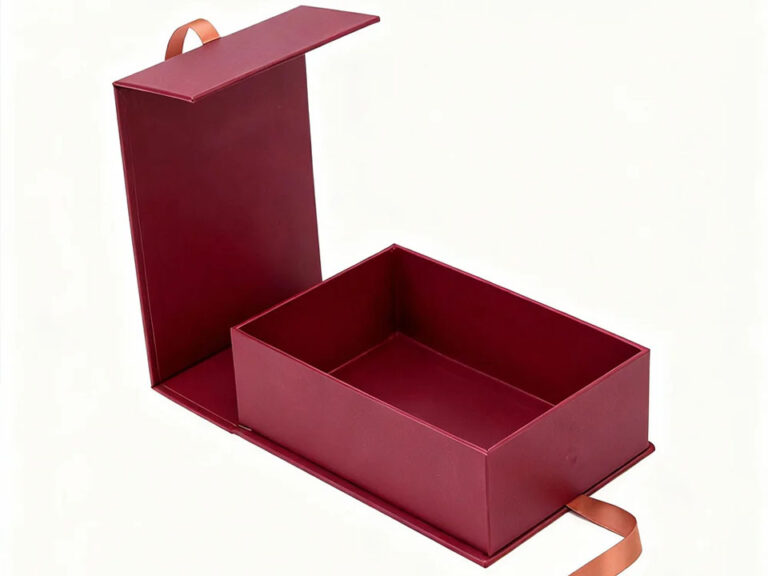
| Double-side open rigid box | Gift sets, launch kits, influencer or PR mailings | High, presentation-led | High with a fitted insert | More construction steps, plus ribbon and hinge details to specify |
| Folding carton (tuck-end) | Single bottles, high-volume retail | Medium | Medium | Less structural rigidity; finish choices drive the premium look |
| Mailer box | Direct-to-consumer shipments | Medium | Medium to high | Needs transit testing with your product weight |
If you sell mainly through retail shelves, a sleeve-and-tray or folding carton may offer the better cost-to-impression ratio. If you sell gift sets or premium launch kits, rigid constructions justify their cost more easily.
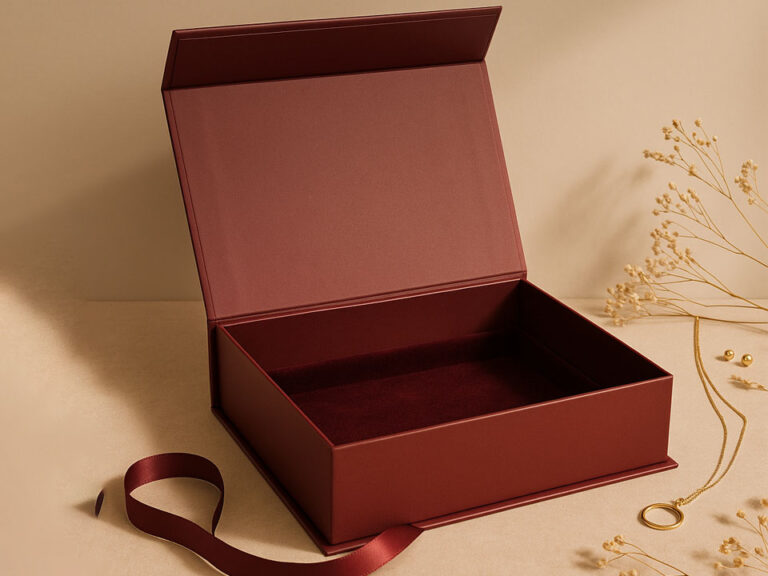
A double-side open structure suits brands that want a presentation moment. The manufacturer’s double-side open CBD essential oil gift box is a useful reference. The product page describes a burgundy exterior with gold-tone details and hinged side panels that open outward. It also lists printed interior panels for product information and brand storytelling, ribbon pull tabs, and a fitted insert with a nested inner carton. The page says dimensions, artwork, colors, interior printing, insert layout, ribbon color and finishing can be adapted to different bottle formats.
The page does not state materials, MOQ, price or lead time, so request those in your quote. The structure also raises some questions to ask a supplier:
You can browse the full custom CBD oil box collection to compare structures before deciding.
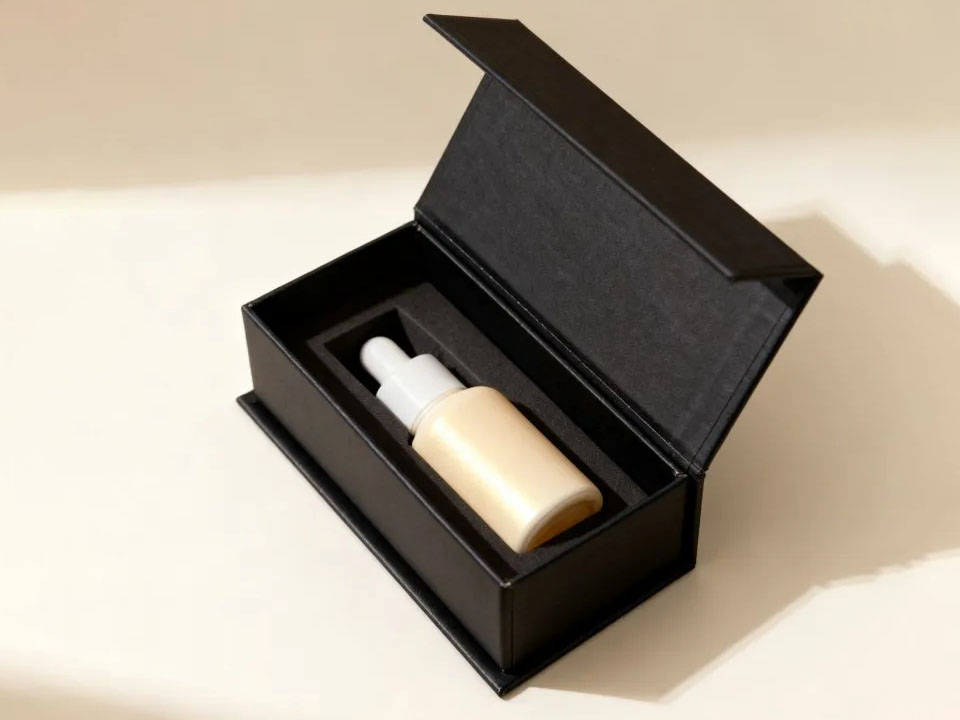
Material and finish choices should follow the brand’s position. They also have to survive handling, shipping and shelf life.
| Finish or feature | What it does | Watch for |
|---|---|---|
| Wrapped printed paper over rigid board | Gives full-color coverage and a smooth surface | Edge and corner wrapping quality; ask for a physical sample |
| Soft-touch lamination | Adds a velvety feel, deepens dark colors | Scuffing on dark colors; ask about abrasion performance |
| Foil stamping | Adds metallic contrast for logos and borders | Fine lines and small type can fill in; set minimum line weights |
| Embossing or debossing | Adds tactile logo or pattern | Needs adequate board thickness and a tooling cost |
| Spot UV | Creates contrast between matte and gloss areas | Fingerprints on gloss areas; registration accuracy |
| Window or die-cut | Shows the product | Reduces structural rigidity and light protection; may need a film patch |
| Recycled or FSC-certified board | Supports sustainability positioning | Verify certification scope if you make claims |
A reasonable approach for most brands is one tactile finish and one metallic or gloss accent. Dark colors show scuffs and fingerprints more clearly, so request samples to check them.
If you use environmental claims on the box, make sure you can document them. Ask your supplier for certification details rather than relying on general statements such as “eco-friendly.”
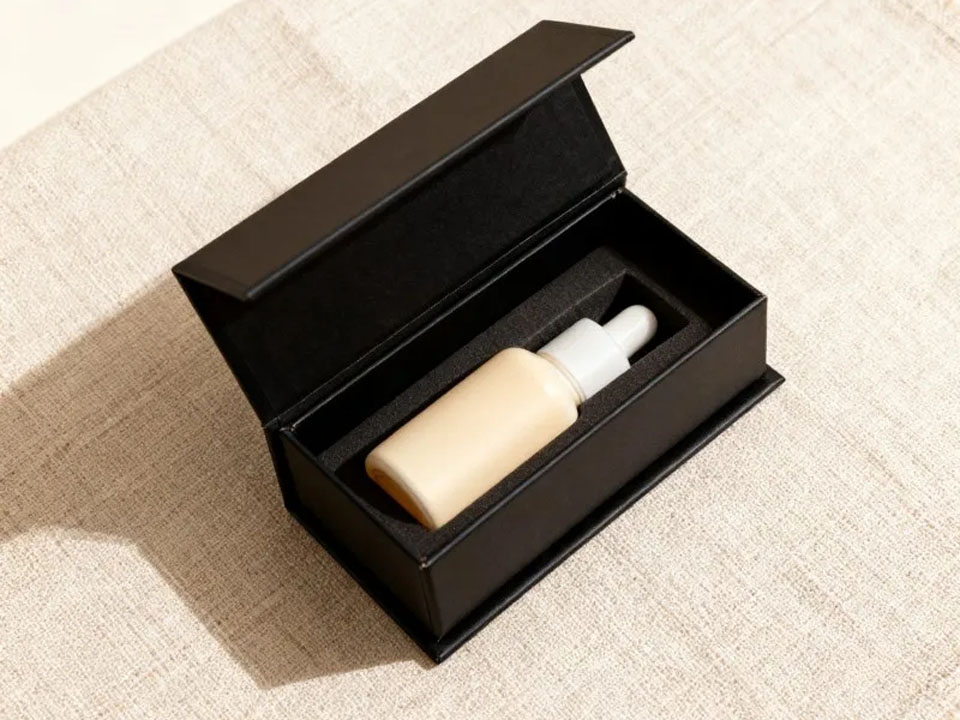
The insert is the part customers feel when they lift the bottle, and it is where many CBD packaging projects go wrong. Glass dropper bottles vary in diameter, shoulder shape and cap height, even among bottles sold as the same size.
When specifying the insert:
A hypothetical example shows the risk. Suppose a brand approves a rigid box using dimensions from a bottle catalog. The production bottles have a slightly wider dropper cap, so the lid no longer closes flush. The fix is a new insert or structure, and the box may be remade. Testing a physical prototype with the actual filled bottle prevents this.
Your packaging may need to carry mandatory label content and claims that meet legal requirements. These rules vary by market and product type, and CBD regulation continues to change. This section is general information, not legal advice.
Claims. The U.S. FDA’s consumer update on cannabis and CBD products states that it is illegal to market CBD by adding it to a food or labeling it as a dietary supplement. It also says some CBD products are marketed with unproven medical claims. The page is marked as current as of 03/05/2020, so check FDA’s latest position and state rules before finalizing copy. For design, this means health-benefit wording on a box carries legal risk, and you should have claims reviewed before artwork is approved.
Child-resistant packaging. Under U.S. rules, the Consumer Product Safety Commission defines special packaging under the Poison Prevention Packaging regulations as packaging designed to be significantly difficult for children under 5 to open, while remaining usable by normal adults. Whether a specific CBD product needs special packaging depends on its category and formulation, and state or market rules may add requirements. Check with a regulatory adviser. Also note that a paperboard box does not make a product child-resistant. Child resistance is typically a property of the closure or container system and requires testing.
Label space. Build required label panels into the dimensional drawing, not as an afterthought. Typical needs include product identity, net quantity, batch or lot information and any market-specific warnings. Leave room for them so the design stays clean.
Unit price is only part of the picture. Compare quotes on total landed cost, which includes:
Cheaper quotes often leave out samples, tooling or inserts. Ask each supplier to quote against the same written specification so you compare like with like.
A good supplier answers specific questions, not only requests for a price. Look for:
For a starting point on supported formats and finishes, review the manufacturer’s page on custom CBD oil boxes for tinctures and wellness brands. It lists options such as inserts, printing, finishes and eco-friendly paperboard. Treat claims on any supplier page, including capabilities, order sizes and shipping terms, as points to confirm in writing during quoting.
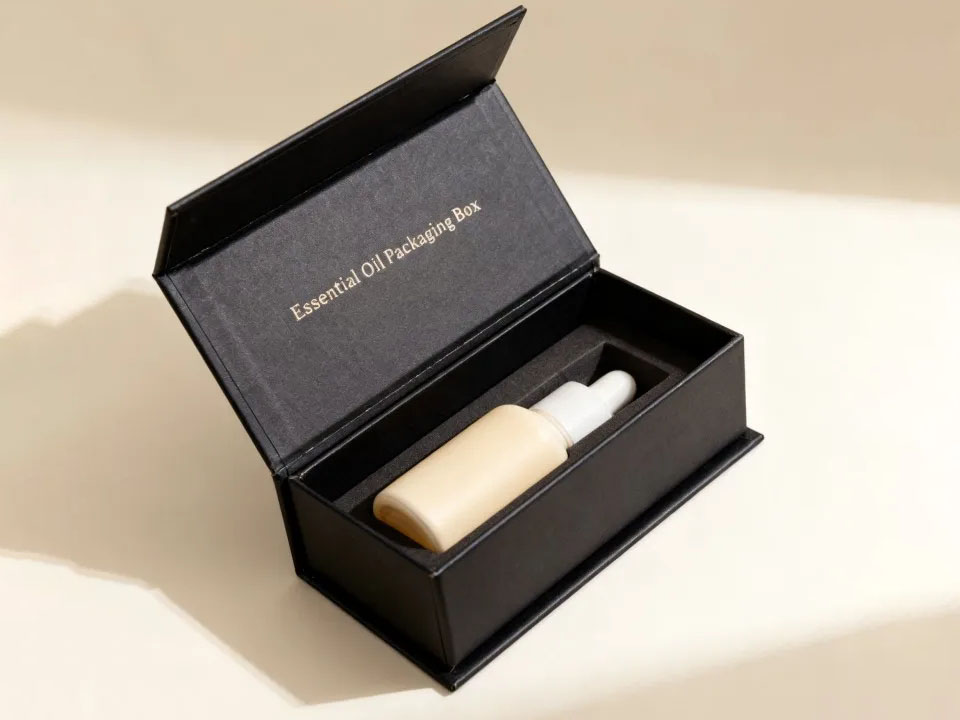
A complete request shortens the sampling cycle and makes quotes comparable. Prepare the following:
Custom CBD boxes are packaging made to fit a specific CBD product, such as a tincture bottle, gummy jar or gift set. They include tailored dimensions, branded print, finishes and inserts. They can be rigid, folding or sleeve-based.
It depends on the product, formulation and market. U.S. Poison Prevention Packaging rules define special packaging, but not every product falls under a standard. Check with a regulatory adviser. A plain paperboard box alone is not child-resistant.
A box reduces light exposure and cushions the product, but the primary container is the main barrier. Research shows CBD can degrade with heat, oxygen and light. Discuss container choice with your formulator and avoid unsupported “UV-blocking” claims.
Soft-touch lamination, foil stamping, embossing and spot UV are common choices. Using one tactile finish and one accent usually looks more refined than combining many effects. Request physical samples to check scuffing and registration.
Send bottle dimensions, filled weight, preferred structure, material, artwork, finishes, insert layout, quantity, destination and target date. A physical bottle sample helps the supplier build the insert accurately.
Rigid boxes feel more premium and protect better, but cost more and use more freight volume. Folding cartons suit high-volume retail or lower budgets. The right choice depends on price point, channel and unboxing goals.
Health claims carry legal risk. FDA’s consumer update notes that some CBD products are marketed with unproven medical claims. Have all packaging copy reviewed by qualified counsel for each market where you sell.
Comments